ADVERTISEMENT

Banner
  

GET STARTED IN SOLAR

Braisin’ in the Sun: Turning Pro in Paonia

Want a solar job? There's no substitute for hands-on rooftop experience. Get it in a world-class training course.


Story and photos by Seth Masia
Published: January/February 2010 issue

Solar Energy International energy lab

After years of fussing around with do-it-yourself energy projects, I knew it was time to learn some professional-level skills. So I signed up for a 10-day course in photovoltaic (PV) design and installation at Solar Energy International (SEI). The course prepares students for the North American Board of Certified Energy Practitioners (NABCEP) entry-level exam and is given, during summer months, over a two-week period at SEI’s renewable energy lab in Paonia, Colo. In colder weather, the course moves to warmer, mostly sea-level locations.

SEI grew out of the small renewable energy community in Carbondale, Colo. During the energy crisis of the early 1970s, Johnny Weiss, Ken Olson, Steve McCarney and a few other forward-thinking contractors began putting up solar houses, partly paid for with Carter-era incentives. By 1980, Colorado Mountain College (CMC), the local community college, had launched a solar energy training program. Over the next decade, Weiss, Olson and McCarney designed and taught courses at CMC.

By 1990, after 10 years of Reagan-era policies, support for community college clean energy courses had just about dried up. McCarney went into the solar business (today he runs Kyocera Solar in the United States; kyocerasolar.com). Weiss and Olson, in discussions with CMC, determined that the training program would do better as a stand-alone nonprofit institution, and in 1991, SEI was born. The pair taught about 200 students that first year, most of them do-it-yourselfers who wanted to put solar, wind and microhydro projects on their own land.

In 2009, about 3,000 students went through the wide variety of courses at SEI, taught by 20 full-time and 30 part-time staffers. All the instructors have real-world experience as installers and solar business owners; about half got their start in solar by taking an entry-level course at SEI. Weiss notes that the majority of today’s students want new careers in renewable energy.


Paonia Proves Ideal


By 2002, the Aspen real-estate boom had washed over Carbondale. The school couldn’t find affordable real estate on which to build an expanded teaching facility, and staff couldn’t find affordable housing. The solution was to buy a farm 40 miles south of town, over McClure Pass in Paonia. That’s where I headed in mid-July.

I took the first half of the course online. The web-based lessons, given over a six-week schedule, were easy and fun — you have to know how to add, subtract, multiply and divide, read tables and graphs and memorize a few formulae. There are homework assignments and a couple of quizzes each week and plenty of email support from the instructors. You need to devote enough time to these tasks to double-check your own work for accuracy. Otherwise, you may specify undersized wiring and burn a house down. I arrived in Paonia with a good grade, up to speed with the class and ready to climb on a roof.

Lodging at Paonia is informal. Most students stay in private homes or B&Bs, renting rooms for $40 a night and up. During the warm months, some students set up in private campgrounds. I stayed in an old farmhouse, one of dozens on SEI’s recommended accommodations list.

When Western civilization collapses, Paonia won’t even notice. This little town enjoys an alpine valley at about 5,600-feet elevation. Paonians grow their own food, especially fabulous fruits. They have vineyards and plenty of water, solar and wind power already in place. They even have their own coal mines, a couple of miles upstream along the road to McClure Pass. It’s weird to work on a rooftop PV install, with renewable energy projects in all directions, and watch a coal train rumble past just yards away.


Career-Changers Pack Class


I joined a class consisting of 30 men and three women, ranging in age from about 26 to about 60. I found a seat in the barn-like classroom between Todd Bevington and Sonnet Baker. Todd is a 40-something sales-and-marketing guy from Denver eager to do something more meaningful with the second half of his career. Sonnet, a 30-something mechanical engineer for Boeing, described plans to cycle across East Asia before tackling the next stage of hers.

Instructors Kris Sutton and Flint Richter led a lecture-demonstration about safe grounding techniques, involving copper grounding spikes, self-tapping screws and many yards of bare copper wire. At lunch, seven of us wound up at Paonia’s sole deli. Shop talk was about state incentives, the price of PV modules and the future of the business.

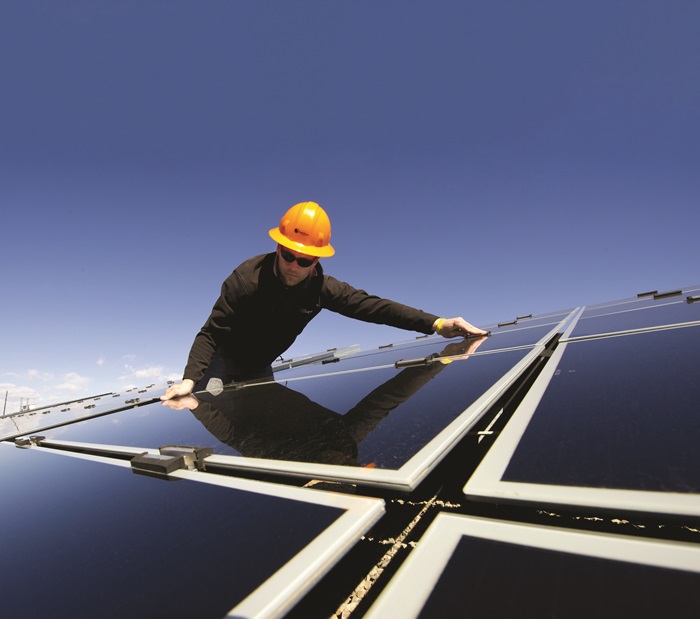
After lunch Kris gave us a safety lecture, concluding, “If you need to use the fire extinguisher, you fail.” Then we split into five groups, each led by an earnest instructor and each dedicated to installing a different form of PV technology. I went with the microinverter group. Our job was to figure out the size and components for a household PV array using Enphase’s new microinverters and then build the thing on a pitched roof. Led by Kyle Bolger, an installer from central Oregon, we did the calculations and checked them against the equipment specifications. We did a quick site evaluation of the roof. Non-slip, closed-toe shoes proved important, along with a straw sombrero, for protection on a sun-baked roof.

That changed. As we bolted up the aluminum rack system, the wind turbine at the back of the property came to life and pointed its nose down valley. Ten miles off, a black cloud spilled rain onto the farms and ranches. When lightning struck a neighboring hilltop, we stowed the aluminum rails under the roof; when the wind began gusting our paperwork around, it was time to close up the tool bins and head for cover. Class dispersed at 4:30 p.m., half an hour early, in fat wind-driven raindrops.

Sun Bakes Panels and Students


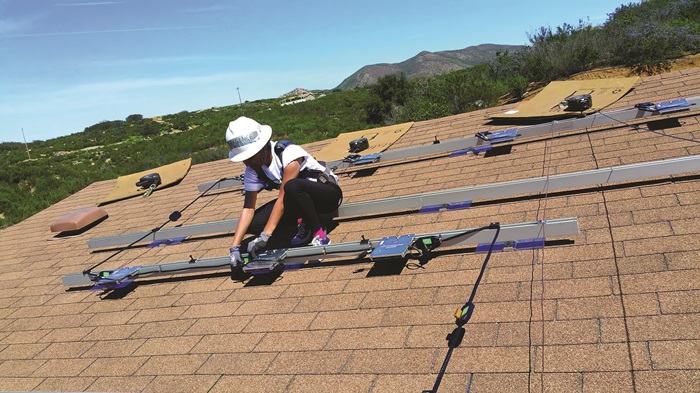
The course is like summer camp. On the second day, we started to figure out how the team would fit together. For instance, young Brendan Pattison, from Nashville, Tenn., is a licensed electrician who does quick, neat work with wire strippers and connections; David Fuller from Massachusetts is a general contractor with a good eye for plumb. Our group of six bolted together 10 175-watt SolarWorld modules and 10 Enphase microinverters. We only had three safety harnesses, so Brendan, David and Mark Deazley hopped onto the roof to assemble the rack and the first row of modules. The rest of us handed up tools and made helpful comments, like, “That doesn’t look straight.” Then Kyle pointed the groundlings at the conduit bits and got us started on the 35 under-roof wiring. Rick Basler hooked up the disconnect box.

After lunch we traded places. Rick, Todd and I climbed onto the roof to bolt down the second row of five modules and complete the electrical connections. We later measured the temperature of the sun-blasted modules at 42°C (108°F), and the asphalt shingles were not cooler. I spent an unpleasant 15 minutes lying flat on my back in the roasting pan, fishing about under the array to snap in the last plugs and tie up loops of cable. Then Kyle walked us through commissioning and testing. Brendan donned the insulated gloves to make the final connections and turn on the disconnect. Nothing smoked.

With the actual temperature of the array in hand and a reading of actual watts-per-square-meter in the late afternoon sun, we predicted a system output for the time of day — about 1,330 watts. The Enphase inverters send data out through their AC cables, so the system provides a nifty web-based readout of real-time performance, module by module. By the time we got data flowing through the Mac interface, it was almost 5:00 p.m., and the modules generated about 1,200 watts. Kris showed us the log for the previous month’s power output. It’s very cool to see the diurnal curve of power in a weeklong chart.


System Gets an A, “Not an A+”


On Wednesday morning, Kris inspected our Enphase system and gave us an A. “Not an A+,” he pointed out. Near the junction box, we’d left too much cable to stuff into the rack rail channels, so I’d fastened the excess up with wire ties. Perfectly safe and workmanlike, but if it were my roof, I’d have cut it to proper length and crimped on new connectors.

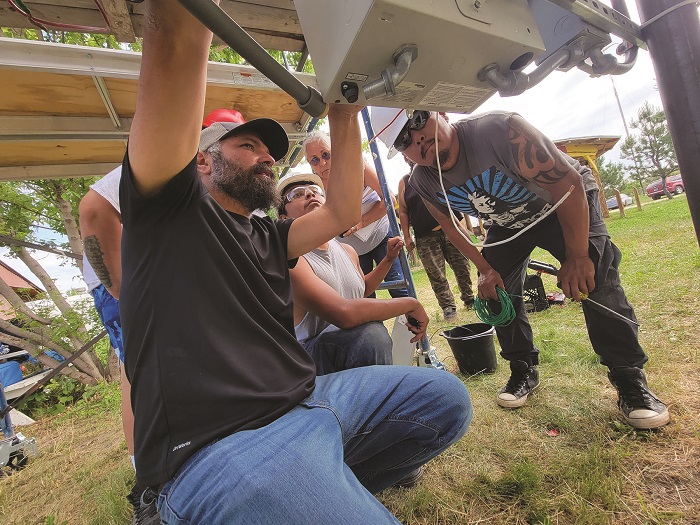
After lunch we toured all five completed projects and got explanations from their crews. The pole-mount gang seemed happiest: Their system went up quickly, and they finished the wiring standing up straight in the shade of their own modules.

Then it was teardown time. We made short work of this: Systems came apart more quickly than they went up because we didn’t have to align anything. The only tricky bit was disconnecting the module cables from the microinverters. You need a special tool to disengage two hooks on the locking connectors. One of the joints stuck and needed four-handed fiddling using hook-nosed pliers.

By mid-afternoon the solar ovens filled up with casseroles, ears of corn and a broiler chicken for the evening potluck supper, with spouses and offspring of the instructor staff in attendance.


Grid Simulator Installs Quickly


The groups reorganized for Thursday and I went with instructors Brad Burkhartzmeyer and Brady Bancroft to learn about the elaborate Sunny Island system. This hybrid charge-controller/inverter was devised by SMA for isolated stand-alone power systems. If you lived on a mountain top or in a remote village far from any grid, you’d want a Sunny Island. The main box simulates a grid, imposing a sine-wave voltage on any current coming in. Any peripheral inverter will see it as a grid and cooperate. You can send in power from a PV array, microhydro generator, wind turbine, battery array or straight from a real utility grid. Assuming more than one power source, if any one goes down, the Island keeps sending out “grid” power.

The cool morning turned into a hot midday. Happily, we didn’t have to work on a roof. The system’s DC side is fed by a 1.6-kilowatt ground-mount array, built as a single string of eight Sanyo bifacial modules. We got it up pretty quickly. Brendan Pattison and Dan Michelson wired up the DC and AC disconnects, while Scott Ostrin and I bruised the heels of our hands plumbing up the rack. I’d add a 10-foot straight-edge and a rubber mallet to the tool kit.

We reconvened in the evening at Paonia’s Revolution Brewery, a tiny bar in what used to be a tiny church. It’s what Alice’s Restaurant must have looked like. The microbrew of choice is SEIPA — Solar Energy International Pale Ale.


Course Ends; Many Stay For More


I had to ask the instructors: What’s the toughest concept to get through to students?

“Solar Kelly” Larson from Northern California didn’t hesitate: “Wire sizing,” she said. “It’s just difficult to account for all the variables that go into determining a safe and efficient gauge for each wiring application.”

Kris Sutton said, “Magnetic declination,” the difference between true south and magnetic south. Guess which one you need to maximize solar gain? In Paonia, the declination is 12 degrees east. Get it straight before you go drinking with Kris.

Most of the students had now been in Paonia for two weeks, and many were staying on for the advanced course the following week. That course focuses on the intricacies of the National Electrical Code.

Friday morning saw final wiring and adjustments on some of the lab projects. Our group spent part of the morning figuring out the voltage drop in the #8 AC line from the PV inverter to the Sunny Island. Then we connected the microgrid inverter to the 48-volt battery bank, the grid transformer and the PV array inverter. We turned everything on and waited 10 minutes while the Sunny Island exchanged data with the other units and came on line.

After lunch, Ed Eaton convened a study group for students taking the NABCEP test that evening. The rest of our group put together a schematic of the Sunny Island rig, suitable for use in explaining the complex system to an inspector.

At 3:30 p.m., Kris, Flint and Kyle conducted a casual graduation ceremony. They handed out the certificates, and everyone promised to let each other know when we found rooftop work. Then we rode off into the sunset.

----------
About the author: Seth Masia is managing editor of SOLAR TODAY. Contact him at This e-mail address is being protected from spambots. You need JavaScript enabled to view it .

+ WEB EXCLUSIVE: See a slide show from Paonia >
+ WEB EXCLUSIVE: Talk with Seth Masia >
+ Order a copy of this issue: This e-mail address is being protected from spambots. You need JavaScript enabled to view it This e-mail address is being protected from spambots. You need JavaScript enabled to view it >
 

Follow ASES

----------
FacebookTwitterLinkedInRSS feed


Current Issue

Jan./Feb.
---------


ADVERTISEMENT

Banner