ADVERTISEMENT

Banner
  

September/October 2008 Issue
 

Training the Green-Collar Workforce


As New York demonstrates, attracting renewable energy business depends on developing a ready supply of skilled workers.

By Adele Ferranti


In a time of economic recession, renewable energy and energy-efficiency businesses represent a bright spot for states eager to generate jobs and revenues. According to the American Solar Energy Society’s recent green-collar jobs report, these sectors represent 8.5 million jobs and nearly $1 trillion in annual revenue in the United States. With supportive policies, the report forecasts, our nation may generate 40 million green-collar jobs and $4.5 trillion in annual revenue by 2030. It’s no wonder states like New York are dedicating millions to attract businesses in these thriving industries — and a vital step is training the workforce for green-collar jobs.

New York has set aggressive goals for renewable energy and efficiency (RE and EE). Gov. David Paterson has directed the state to reduce electricity usage 15 percent by 2015, while increasing the portion of electricity generated from renewables to 25 percent by 2013. In order to meet these objectives, we’ll need thousands of new workers in RE and EE.

Ready access to skilled labor is especially critical for emerging solar installation companies. National solar integration firm groSolar, for example, in just five years has grown its New York branch from one sales person and travel crew to an office staff of five plus a full-time installation crew. “At our rate of expansion, we’re inventing a lot of processes,” says CEO Jeff Wolfe. “So competence is a must. The competence of our people may well be the difference between our success and failure in the downstream solar markets.”

For a decade the New York State Energy Research and Development Authority (NYSERDA) has been training the state’s workforce in how to design, purchase, install, service and maintain efficiency technologies and measures. From training in boilers, motors, HVAC equipment and insulation to air-quality testing and green building design, our programs provide specialized training to skilled workers, retrain displaced workers, give high school students a career path and provide continuing education credits for workers at all levels. To support the incentive programs NYSERDA launched in 2001 and 2002 to encourage efficiency upgrades and renewable energy system installations respectively, we developed training for providers of these services. Highly trained, reliable contractors and installers are the key to properly performing systems, happy consumers and, ultimately, a solid renewable energy economy.

Today New York has dedicated a multi-million-dollar budget to training. We provide training options across trades and skill levels, delivered at technical high schools and two- and four-year colleges. Dozens of training partners statewide offer this training.

The results are promising. In terms of PV industry growth alone, from late 2002 until the end of 2007 the workforce grew from 12 NYSERDA-approved photovoltaic installation firms to more than 125 approved firms. Since the PV incentive program was revised in early 2008, we’ve approved 78 participating firms, with new firms joining monthly. These qualified installers buttress NYSERDA’s New York Energy $mart PV Incentives program, generating about $86 million in PV sales statewide since the program’s launch. When combined with federal and state tax credits, these cash incentives can offset a PV system’s total installation cost 40 to 65 percent. Since 2002, the program has helped fund more than 1,400 systems totaling 9.79 megawatts.


Building a Market in New York

New York, like other progressive jurisdictions, is positioning to be a national leader in renewable energy and efficiency. To support state initiatives for RE/EE business development, Gov. Paterson convened a Renewable Energy Task Force last fall. This Task Force recently issued a policy roadmap for RE development in the state. A central element of the roadmap is expanding training programs to sustain a green-collar workforce — particularly in the emerging sectors of renewable energy research, development and installation.

The Task Force is working with all New York agencies that provide workforce training, including NYSERDA, to develop programs tailored to the needs of the state’s growing renewable energy sector. In cooperation with other state entities, NYSERDA is addressing these needs through its Residential Efficiency & Affordability Program (REAP). REAP is designed to increase the number of RE system designers and installers, qualified building-performance contractors and raters, builders of energy-efficient homes and other professionals serving the residential sector.

Training the Home-Efficiency Contractors

REAP training for residential building professionals is closely coordinated with other NYSERDA training initiatives developed for energy-efficient commercial and industrial systems/services and the manufacturing sector. These activities include training on lighting products and systems, wastewater treatment operation, building operation, building systems, green and LEED buildings, and commercial HVAC systems. The program supports our consumer incentives for efficiency, which require the use of qualified — and in some cases, certified — contractors.

Because the contractor’s ability to deliver high-quality energy services is fundamental to creating a sustainable RE/EE market in New York, NYSERDA has championed the development of best practices and certifications. We work with several organizations that maintain nationally recognized standards, certifications and accreditations in support of our training programs. Incorporating these national standards into programs helps ensure a qualified pool of contractors, and it assures homeowners of good system installations.

NYSERDA’s energy-efficiency and building science training was developed in concert with standards developed by the Building Performance Institute. BPI is the national resource for standards and best practices, as well as certification and accreditation procedures for assessing and improving the energy performance of homes. A number of NYSERDA’s programs require participants to achieve BPI certifications and/or accreditation.

For high-quality training for home-improvement contractors, NYSERDA has partnered with the Onondaga, Cortland, Madison Counties Board of Cooperative Educational Services (OCM BOCES) since 1999. Training began in OCM BOCES’ Syracuse, N.Y., facility, and resulted in a training road show, bringing the instructors and training equipment where needed to meet student demand. During the several years OCM BOCES conducted classes, more than 1,200 people were trained for work as building analysts, heating professionals, cooling professionals and building-envelope professionals. The training was designed to prepare students for BPI’s certification exam and accompanying field test.

As homeowner demand for energy-efficiency improvements grows, NYSERDA needed to expand the training developed by OCM BOCES. As a result of a competitive solicitation in 2006, we selected Hudson Valley Community College in Troy, N.Y., to develop a statewide network of 10 residential energy-efficiency learning centers. Building on the curriculum developed by OCM BOCES and owned by NYSERDA, Hudson Valley created the Center for Energy Efficiency and Building Science, or CEEBS, and rolled out a portfolio of residential building training courses in 2007. Once CEEBS was launched at Hudson Valley, other learning centers were recruited to join CEEBS.

Today, eight partners have launched centers, and the final two centers are expected to join by year-end. The learning centers are spread statewide, at OCM BOCES, Erie County Community College in Buffalo, Bronx Community College, Broome Community College in Binghamton, Westchester Community College in Valhalla, the Association for Energy Affordability in Bronx, Fulton-Montgomery Community College in Johnstown, and at Hudson Valley. These learning centers are on pace to train 1,000–1,500 practitioners annually and to continue expansion.


Training the RE Professionals

NYSERDA’s REAP also includes a growing portfolio of training for renewable energy professionals. To ensure high standards, we work closely with and financially support the industry’s accreditation and certification bodies.

The Institute for Sustainable Power develops and maintains international standards for evaluation and qualification of RE, EE and distributed-generation training providers. The North American Board of Certified Energy Practitioners is a volunteer board of renewable energy stakeholders who created a certification program for renewable energy installers, designers and inspectors. By working with ISP and NABCEP, NYSERDA is able to provide third-party-accredited training programs and to certify designers and installers of PV, small wind and other renewable and distributed-generation systems.

To meet strong demand in New York, we initially focused on training PV system installers. Since 2002, NYSERDA has provided nearly $1 million to seven training organizations to develop ISP-accredited PV training programs. As NYSERDA partners, SUNY Farmingdale, SUNY Delhi, Ulster County BOCES, Alfred State College, Hudson Valley Community College, Bronx Community College and the International Brotherhood of Electrical Workers have developed nationally accredited PV training programs statewide. Our PV training partners offer courses ranging from introductory one-week classes to credit-bearing classes and one-year certificate programs. More than 800 practitioners have been trained in PV design and installation.

Job placement is part of these initiatives. To earn ISP accreditation, NYSERDA’s training partners must have job placement programs. Through internship programs, students gain real-world experience — and hosting installation companies gain access to potential employees.

According to Wolfe, access to NYSERDA trainees and market-development funds has enabled groSolar to bring people on staff for on-the-job training fast and economically. As a result, the New York office has increased its closing rate and reduced installation costs.

NYSERDA is developing new training programs for PV, small- and large-scale wind systems, fuel cells, digesters, geothermal and solar thermal systems. We’re dedicating $6 million for these initiatives.


Creating a Green Economy

In order to create an abundant supply of qualified RE and EE workers, we also need to develop a corps of capable educators and dynamic training strategies.

In March Hudson Valley Community College hosted the second national conference on “New Ideas in Educating a Workforce in Renewable Energy and Energy Efficiency.” This conference — sponsored by NYSERDA and organized by the Interstate Renewable Energy Council, the Partnership for Environmental Technology Education and Hudson Valley — focused on instructional strategies, curricula development and related trends. Approximately 350 attendees participated, representing 33 states, 37 community colleges, 19 technical colleges and guests from Germany, Australia and Canada. (Download conference papers at .)

Such efforts are invaluable as policymakers and educators work to develop the millions of U.S. green-collar workers needed to meet fast-growing demand. But it may be the most important thing we can do to help RE/EE businesses succeed. “We need people with solid skills that we can train,” says groSolar’s Wolfe. “Make the training available on a very regular basis, and make the hurdles to get into training low.”

As New York has found, meeting these demands is no small challenge. But it’s one worth achieving, for the consumers who have access to high-performing renewable energy systems. For businesses that, equipped with skilled workers, are driving statewide economic growth. And not least of all, for a world so in need of these technologies and solutions.

Adele Ferranti manages the Market and Community Support Program for NYSERDA’s residential efficiency programs and NYSERDA’s workforce training initiatives. Previously, for more than 15 years she was project manager in NYSERDA’s R&D group, where she managed a $28 million portfolio of PV programs and initiatives designed to build a market infrastructure in New York. For more information about NYSERDA and its workforce-training initiatives, access
nyserda.org and getenergysmart.org.


Online Extras —


Delaware Teens Learn Solar Trade

Photovoltaic system installers in Delaware will soon have a new source of personnel: high school grads eager to hone skills learned through an installation at their school.

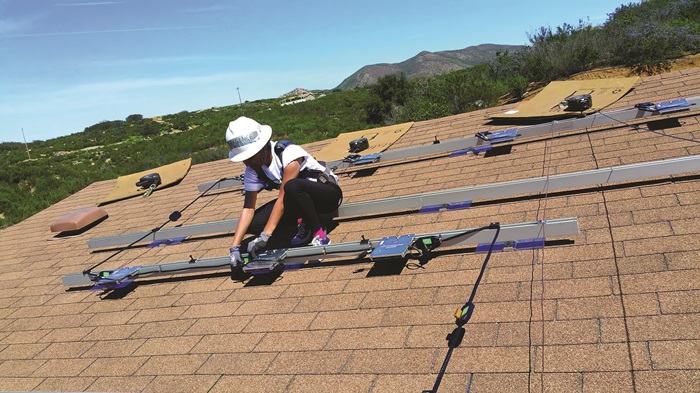
Nineteen students — all 11th graders at Hodgson Vo-Tech in Newark, Del. — concluded training in the inaugural Junior Solar Installer program by installing 10 PV panels on the school roof in May. Instructors Bob Myers and Alan McMillan, along with local solar professionals, provided technical support. The three-week solar program is part of the school’s three-year electrical trade curriculum.

A certified solar installer, Myers recognized Delaware’s demand for workers to support the state’s mandate for 2 percent of retail electricity to be produced from photovoltaics by 2019. With General Electric’s PV facility within a mile of the school, he also knew that GE installation contractors could be a ready source of jobs for Hodgson graduates.

After Myers approached GE about creating a training program, GE worked with the Scott Lynch from the Delaware Energy Office to secure $10,000 to fund the Hodgson program. GE donated another $3,500 for textbooks. Hodgson Vo-Tech’s solar curriculum was designed to be a model for other training programs in Delaware.

Students in the solar class participated in an installation from design and scaffolding to running wires. KW Solar Solutions General Manager Dale Wolf and his staff walked students through the installation. Now seniors, several will continue their solar training with co-op experience at local installation firms.

An interconnection agreement with the local utility will enable electricity produced by the 2-kilowatt system to offset a small amount of the school’s needs. But the system’s greatest value will be in the lessons learned each spring, when a new group of electrical trade students disassembles and installs it.

“If we can help these students get excited about green energy, it will benefit them and all of us in the future,” says Myers. “It could jumpstart a whole industry in this country.”

>> See video from the Hodgson Vo-Tech solar installation.

— Regina Johnson


RESOURCES for Energy Workforce Training

“Defining Energy Technologies and Services” report helps educators develop relevant curriculum. Free download from the Advanced Technology Environmental and Energy Center, ateec.org.

“Green-Collar Jobs in America's Cities: Building Pathways Out of Poverty and Careers in the Clean Energy Economy” by the Apollo Alliance and Green for All, with the Center for American Progress and the Center on Wisconsin Strategy. Free download at apolloalliance.org/downloads/greencollarjobs.pdf.

Interstate Renewable Energy Council develops quality and competency standards for renewable energy professionals and training programs, irecusa.org.


Cities Train Urban Residents for Green Jobs

Seeing opportunity in the shortfall of workers to support emerging green industries, enterprising cities nationwide are training urban residents for a pathway out of poverty.

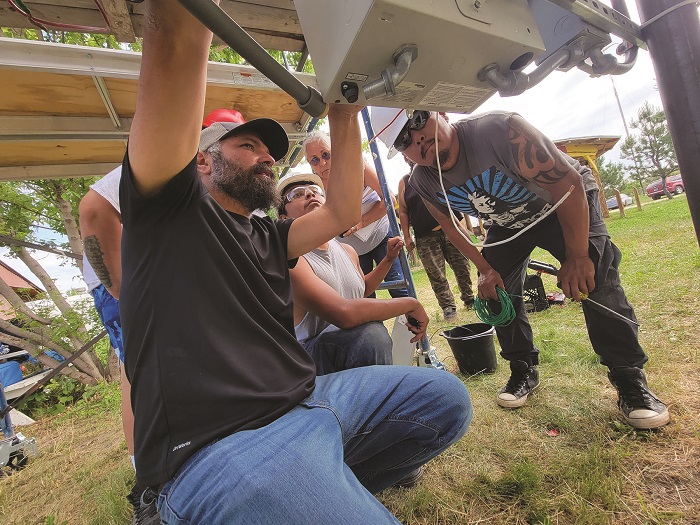
In Richmond, Calif., low-income residents are learning the solar trade through free and low-cost installations on neighbors’ low-income homes. Nonprofit Solar Richmond (solarrichmond.org) has partnered with two organizations to provide training: Richmond BUILD, the city’s low-income residential assistance and construction training program; and GRID Alternatives, a nonprofit that installs solar systems for low-income homes and provides solar training. Last year 32 Richmond residents completed 10 weeks of training from Richmond BUILD and Solar Richmond. By December, all but five graduates had found jobs.

Chicago has offered green-collar job training through GreenCorps Chicago for more than a dozen years. The nine-month course trains participants, primarily ex-offenders, in one of four tracks: landscaping and urban gardening, computer refurbishing and recycling, household hazardous waste handling, and home weatherization. Trainees gain experience by building community gardens and refurbishing computers for low-income residents.

In an effort to transform a low-income neighborhood in Newark, N.J., into a green mixed-use development, the Lincoln Park Coast Cultural District (lpccd.org) is cultivating green-collar workers. LPCCD partnered with CentrALL, a New Jersey HVAC, electrical and plumbing business, to train Newark residents in the trades. In February the partners launched the Green Collar Apprenticeship Program, or Green-CAP, to provide on-the-job training on LPCCD’s residential projects and enrollment in trade programs. Green-CAP graduates will earn licenses and certificates demonstrating their training in green construction.

Find details of these and other urban training programs in “Green-Collar Jobs in America's Cities,” apolloalliance.org/downloads/greencollarjobs.pdf.
 

Current Issue

July/August 2010
---------


ADVERTISEMENT

Banner